Exercise is, without question, the most powerful intervention we have for improving long-term health, slowing age-related decline, and preserving independence as we get older. My own perspective on exercise has evolved significantly over the years. I used to place nutrition at the top of the hierarchy, but the data have become increasingly clear: consistent, well-designed exercise does more to reduce all-cause mortality and prevent both cognitive and physical decline than any other modifiable behavior.
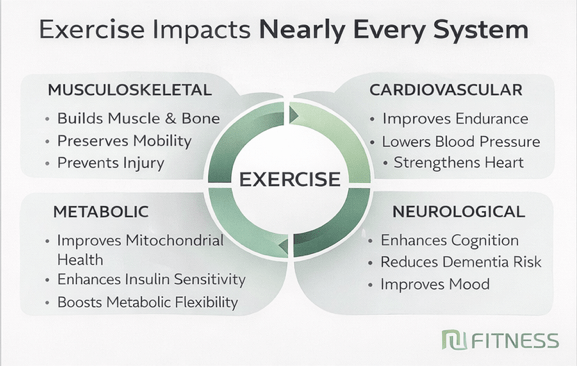
Unlike interventions that target one system in isolation, exercise exerts a broad, compounding effect across nearly every system in the body—musculoskeletal, metabolic, cardiovascular, neurological, and cognitive. When done correctly, it doesn’t just add years to life; it adds capacity, resilience, and quality to those years.
To think about exercise tactically, it’s helpful to break it down into distinct components, each serving a specific purpose for long-term health and aging well.
The Four Pillars of Exercise
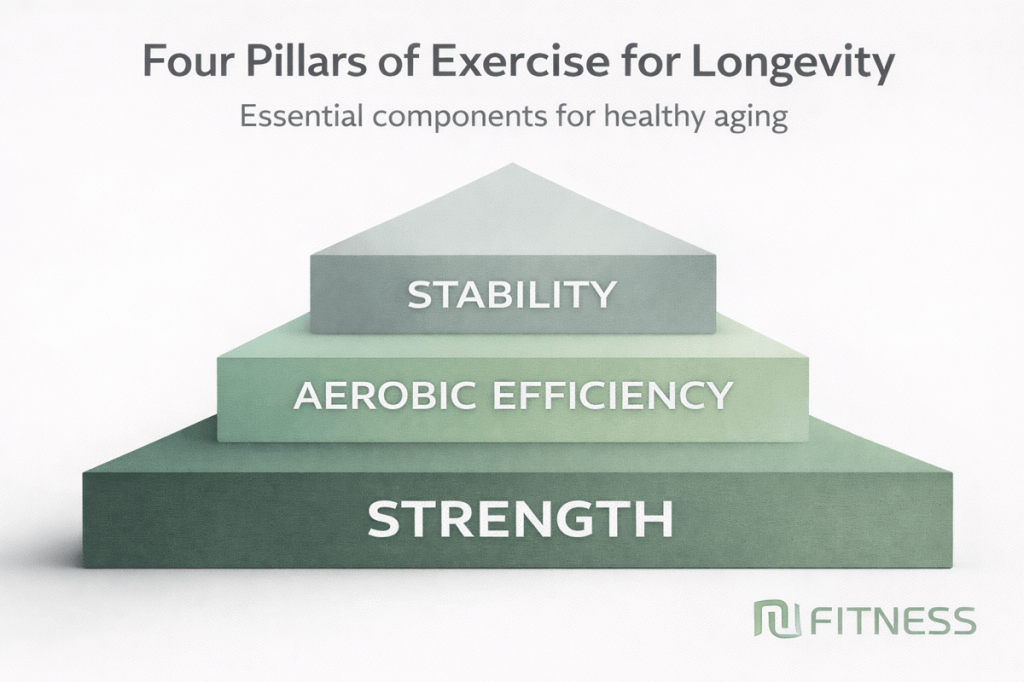
Exercise is often treated as a single behavior, but not all exercise produces the same outcomes. To maximize its impact on healthspan and lifespan, training should intentionally address four pillars:
- Strength
- Stability
- Aerobic efficiency
- Peak aerobic capacity (VO₂ max)
All four matter, but strength sits at the center of longevity.
Pillar 1: Strength — The Cornerstone of Aging Well
Strength training is not primarily about aesthetics. It is about preserving function, independence, and resilience as the body ages.
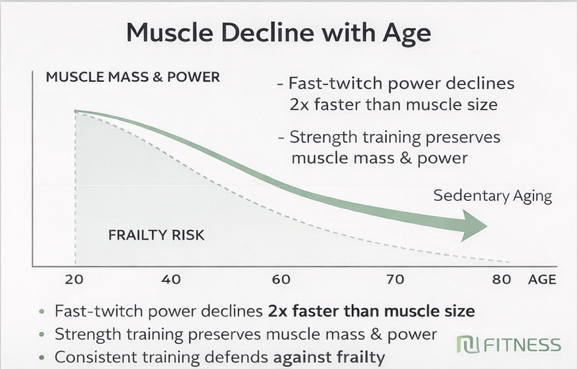
Beginning as early as our 30s, we experience a gradual decline in muscle mass, muscle strength, and power. This process accelerates with age, and without intervention, it becomes one of the strongest drivers of frailty, falls, loss of independence, and mortality later in life. Importantly, it is not just the loss of muscle mass that matters—it is the loss of force production and power, which directly affects how well we can interact with the world.
Why Strength Matters for Longevity

Muscle strength is one of the strongest predictors of survival across the lifespan. Individuals with higher levels of strength consistently show lower risk of death from all causes, even when accounting for cardiovascular fitness and other health markers.
But longevity is not just about survival. Strength determines whether you can:
- Get up from the floor unassisted
- Carry groceries, luggage, or a child
- Climb stairs without hesitation
- Absorb an unexpected stumble without falling
Strong muscles protect joints, reinforce connective tissue, and provide the physical buffer that allows us to tolerate stress—whether that stress comes from daily life, illness, or injury.
Strength, Bone, and Structural Integrity
Strength training places controlled stress on bones and connective tissue, signaling the body to maintain or increase bone density. This is critical for reducing fracture risk, one of the most devastating and life-altering events in older adults. Muscle and bone act as a unit; neglect one, and the other suffers.
Strength and Power: The Often-Missed Piece
As we age, fast-twitch muscle fibers—the ones responsible for power—decline more rapidly than slow-twitch fibers. This loss of power, not just strength, is a major contributor to falls and loss of mobility. Training that includes intent to move weight with speed (while maintaining control and safety) helps preserve this capacity and keeps movement sharp and responsive.
Strength as a Long-Term Investment
Strength training is best viewed as a long-term investment in your future self. The muscle and bone you build today create a reserve you can draw from later in life. Maintaining strength is far easier than rebuilding it after decades of loss, injury, or inactivity. The earlier and more consistently you train, the larger and more protective that reserve becomes.
Pillar 2: Stability — The Foundation That Makes Strength Useful
Stability underpins every movement you perform. It is the ability to control position, decelerate force, and coordinate joints and muscles automatically. Without adequate stability, strength cannot be expressed safely or effectively.
Many injuries labeled as “acute” often stem from long-standing stability deficits that create poor movement patterns and excessive stress over time. Strength without stability is fragile; stability allows strength to be durable.
Pillar 3: Aerobic Efficiency — Supporting Metabolic Health
Aerobic efficiency reflects how well your body uses oxygen during sustained, moderate-intensity activity. Training at lower intensities builds mitochondrial health, improves fuel utilization, and supports metabolic flexibility—the ability to switch between burning fat and glucose efficiently.
This type of training plays a key role in preventing insulin resistance, supporting cardiovascular health, and maintaining the energy capacity required for daily life.
Pillar 4: Peak Aerobic Capacity (VO₂ Max) — Preserving the Ceiling
VO₂ max represents your maximum ability to deliver and utilize oxygen during intense effort. It is one of the strongest predictors of longevity and functional capacity. Higher peak aerobic capacity is associated with lower mortality risk and greater resilience to stressors like illness or surgery.
While it requires less volume than other pillars, periodic high-intensity training helps preserve this “ceiling” and keeps everyday tasks well below your maximum effort as you age.
Bringing It All Together
Exercise is not just something you do—it is the most powerful tool you have for shaping how you age. When training intentionally addresses strength first, supported by stability, aerobic efficiency, and peak capacity, it builds a body that is capable, resilient, and adaptable across decades.
At Nu Fitness, we don’t view training as a short-term solution or a means to burn calories. We see it as a long-term strategy for preserving independence, preventing disease, and maintaining the physical capacity to fully participate in life—for as long as possible.
If you’re going to pull one lever for long-term health, make it exercise—and make strength the foundation. Get a free longevity fitness consultation with a Nu Fitness specialist 🔗here!

 Nu Fitness Oakland Blog